

About Palette & Spindle
Meet The Artists
Learn more about the artists through their personal statements
Shari Glaser | Fiber Artist
I am a lifelong, self-taught knitter who began my fiber journey as a young child when my mom taught me to crochet. As an adult, I picked up knitting with my German sister while studying abroad in college. My grandmother taught me to hand-quilt and I will never forget her often saying, "Oh kid, you can make your stitches smaller". These early exposures to traditional handcraft rooted my love for natural fibers and slow, intentional making.
For years, I dreamed of spinning my own yarn. One Christmas, my husband Greg gifted me a class at the Kalamazoo Institute of Arts—and that single experience opened the door to a deep and ongoing exploration of fiber arts. Since then, I’ve happily gone down the rabbit hole of learning, experimentation, and discovery, which includes weaving, dyeing, and other fiber-related activities. I have Emily and Gretchen to thank for launching me on this adventure and guiding me along the way.
I am process-driven rather than product-focused, finding joy in exploration, repetition, and growth. I gravitate toward jewel tones and the colors of water and nature, often inspired by texture, movement, and the tactile qualities of fiber. I’m rarely working on just one project at a time and am continually trying new patterns, techniques, tools, and equipment as a way to expand both skill and understanding.
Fiber arts, for me, are a practice of curiosity, patience, and connection—to materials, tradition, and creative possibility.
Greg Rosine | Watercolor Artist
I began working in watercolor about eight years ago, drawn to it for what I thought would be its simplicity. After all, it’s often the first medium children are introduced to in grade school. So how difficult could it be? I quickly discovered, however, that watercolor is anything but easy. In fact, many consider it the most challenging of all painting mediums—and that challenge is exactly what keeps me engaged.
I’m primarily drawn to landscapes, with the occasional still life finding its way onto my paper. I enjoy painting loosely, sometimes edging into abstraction, allowing suggestion and mood to take precedence over strict detail. What fascinates me most about watercolor is how it moves and mixes on the paper in ways that can’t be fully controlled. Mistakes are difficult—sometimes impossible—to correct, yet those same missteps often become “beauty marks,” adding character and life to a painting that couldn’t have been planned.
Much of my time is spent before the brush ever touches the paper. I think carefully about composition, light, and values, knowing that these decisions matter far more in watercolor than any attempt to fix things later. Once the painting begins, it becomes a balance between intention and letting go.
I’m often surprised by my own reactions to finished work. At first glance, I may not like a painting at all. Given some time and distance, I’ll come back to it and discover, wow, I really like that. I paint first and foremost for myself, guided by what feels honest and visually pleasing to me rather than by outside expectations. I am so thankful for the other watercolor artists I have painted with and learned from over time, their friendship, advice and guidance has been invaluable. A special shout out to the Kalamazoo Institute of Arts, Kirk Newman Art School, an incredible community asset.
My wife is a fiber artist, and creativity is a shared part of our lives. We spend most of our summers sailing on Lake Michigan, where water, light, weather, and Michigan's beautiful shoreline provides inspiration. The act of sailing is finding a balance between the competing forces of wind and water. Creativity is like that.
Tools of the Trade
Fiber Tools
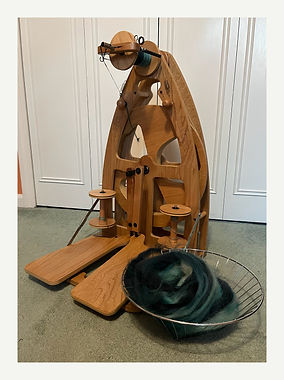
I use a variety of fiber tools that depend on the projects I’m creating. Typically, I will have a knitting project in process, a project on either my floor loom or rigid heddle loom (or both!) and one or more spinning wheels in play. My floor loom “the Lady Dowager”, is a restored 40” 8S Macomber loom, built in 1952. “Jayne” is a Timbertops 24” Saxony spinning wheel built in England. “Jolene” is an Ashford Joy 2 spinning wheel, perfect for traveling and workshops. (And yes, it’s quite common for fiber artists to name looms and wheels.)
Along with these “major” pieces of equipment, I also use a variety of other fiber tools, including an electric eel wheel nano, an inkle loom – hand crafted by my brother, hand cards, combs, blending board, etc. My room has two closets (thankfully!). One houses all my weaving accessories and yarns, and I store spinning fibers and knitting/spinning equipment in the other closet. Sewing machine and serger are also ready to use with a well-equipped sewing box.


Watercolor Tools
Watercolor tools are pretty simple; brushes, paint, paper and water. There are other things that get some use, a spray bottle for additional water, the edge of an old credit card to scrape, a ruler or straight edge, a pencil and eraser, and some other items.
The brushes, paint, and paper are the basics. I use a combination of brushes with natural hair and synthetic hair. Even though I have a number of brushes, I tend to rely on 3 or 4 for most work. The paint is from several providers, but always professional grade with a lot of pigment. The paper is alway 100% cotton of a certain weight. I buy the paper in sheets and I usually tear the sheets into 4 pieces that are roughly 11x15 inches.
I tend to paint at a desk but also rely on an easel I made from a cheap camera stand. Pretty simple stuff.


